
Transforming confined space entry safety and monitoring of critical tasks
Published by Ellie Brosnan,
Editorial Assistant
Tanks and Terminals,
In this special report, Dräger explores how digital systems can help mitigate challenges and risks within confined space entry operations for industrial applications, such as tanks and terminal environments.
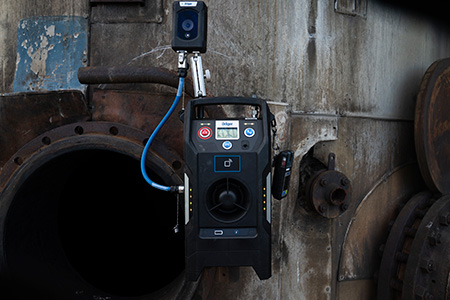
Confined space entry (CSE) remains one of the most demanding and risk intensive tasks in industrial operations. Workers entering tanks, vessels, columns, or sewer systems face restricted access, limited visibility, and atmospheres that can shift from safe to dangerous within moments. Even the most experienced safety guards stationed at the entry point can monitor only what they can see and hear. They cannot observe conditions deep inside a tank, detect sudden atmospheric changes in real time, or oversee several entries simultaneously during busy maintenance periods.
As industrial plants continue to face these long standing challenges, digital safety technologies are transforming how confined spaces are monitored. INARA, the world’s first digital safety guard, was created specifically to bridge the limitations of human supervision. Designed for environments where visibility is restricted or access is hazardous, INARA provides continuous visual and atmospheric monitoring, identifies who is inside the work area, and reacts instantly when critical conditions arise.
Enhanced visibility inside confined spaces
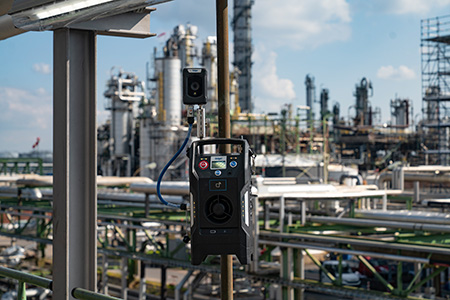
Limited visibility has always been one of the greatest obstacles in confined space safety. Once workers pass through a narrow manway, safety guards lose direct sight of what happens inside. Operators have traditionally depended on radio communication, periodic gas measurements, and worker feedback – methods that provide only partial insight into internal conditions.
INARA offers continuous visibility for the first time. Explosion protected cameras and gas sensors can be positioned at or inside the confined space, giving operators an uninterrupted real time view. The system monitors atmospheric conditions and worker activity around the clock. If gas levels rise, oxygen drops, or other dangerous conditions develop, INARA immediately triggers alarms and activates predefined procedures. In confined spaces, where hazards escalate in seconds, this capability significantly improves response time and worker protection.
Supporting safety in dynamic industrial environments
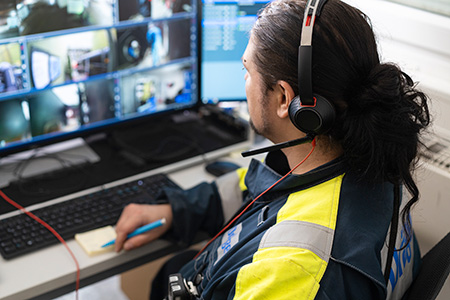
Confined spaces rarely remain stable for long. Maintenance activities such as welding, cleaning, coating, or inspection can rapidly shift internal conditions. Traditional periodic gas checks cannot keep pace with these changes. INARA’s integrated sensors continuously assess the atmosphere and react the moment hazardous values are detected.
Beyond environmental monitoring, INARA also supports safe evacuation. The system identifies exactly who is inside the space, helping ensure no one is overlooked during an emergency. This function is critical during large maintenance events, where multiple teams may work across several vessels at once.
Scalable safety during turnarounds
Turnarounds and major maintenance campaigns intensify the challenges of CSE. Many confined spaces may be open simultaneously, requiring extensive staffing to maintain acceptable levels of supervision. Traditionally, operators responded by bringing in large numbers of trained safety guards – a costly and difficult approach during already resource heavy shutdowns.
INARA provides a more scalable alternative. Offered as a complete service, customers rent the digital safety devices along with trained personnel who operate them. INARA units can be deployed in higher numbers during peak work periods and kept on standby, without cost, when not required. This flexibility helps refineries, petrochemical plants, and chemical facilities maintain consistent safety standards while easing staffing pressures during demanding maintenance phases.
Beyond confined spaces: a versatile industrial safety tool
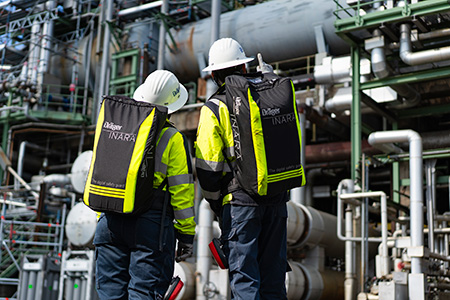
Although CSE is a central application, INARA was not designed solely for confined spaces. Its ability to operate reliably in hazardous or hard to reach areas makes it suitable for overseeing welding operations, work at heights, and large work zones where continuous oversight is essential.
A global model for consistent safety standards
For multinational companies, maintaining consistent safety practices across sites is an ongoing challenge. Regulations differ, and availability of qualified safety staff varies. Dräger’s global service model addresses these issues by providing standardised monitoring systems and trained operators worldwide. Because one operator can supervise multiple units at once, on site staffing requirements are reduced, and safety practices remain consistent across all locations.
This also simplifies administration. Instead of managing equipment, staffing, and logistics internally, companies rely on INARA’s team to handle setup, operation, and maintenance, allowing plant personnel to focus on core processes.
Looking ahead: AI enhanced industrial safety
The development of INARA continues, with additional sensors such as temperature and humidity being integrated. Looking forward, artificial intelligence may enable the system to detect missing PPE, identify unsafe behaviours, or recognise dangerous situations without human intervention.
Advancing vision zero in confined space entry
Confined space entry will always involve inherent risks, but digital systems such as INARA are significantly reducing them. Through continuous visibility, real time hazard detection, and scalable deployment, INARA supports the Vision Zero mission of ensuring every employee returns home safely, while setting a new benchmark for safety across a wide range of high risk industrial environments. Its cost efficient design, constant availability, and next level safety performance further strengthen its role as a groundbreaking standard for high risk industrial environments.
For more information visit: Dräger INARA | Draeger
Read the article online at: https://www.tanksterminals.com/special-reports/01042026/transforming-confined-space-entry-safety-and-monitoring-of-critical-tasks/