
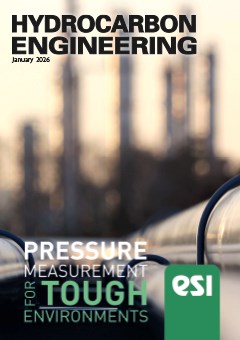
January 2026
The January issue of Hydrocarbon Engineering 2026 opens with a review of the downstream sector throughout 2025 by Wood Mackenzie, with a focus on dynamics of markets in surplus for the year ahead. Further articles offer technical discussion with detailed case studies covering alternative fuels, sulfur, emissions control, flaring, digital innovations, water management, process control, instrumentation, and automation, and many more.
This month's front cover is brought to you by ESI Technology Ltd.
Register for free »
Get started now for absolutely FREE, no credit card required.
Contents
Comment
News
The rollercoaster ride of ‘25
Alan Gelder, Wood Mackenzie, UK, reflects on the turbulence the downstream sector faced throughout 2025, with a particular focus on dynamics of markets in surplus for the year ahead.
China’s sustainable methanol surge
As China scales up renewable power at a record pace, Sean Xiong, Johnson Matthey, China, considers the development of sustainable methanol production that is emerging as a central pillar of its energy transformation and a potential blueprint for global decarbonisation.
Readying renewable diesel
Jim Aiello, Merichem Technologies, examines the role that renewable diesel could play in the shift to cleaner transportation fuels, alongside an exploration of desulfurisation technology.
Simplifying sulfiding
Traditional sulfiding agents pose operational challenges as well as health and safety risks for operators in the sulfiding process. Jennifer Jackson, Lubrizol, USA, considers how alternative agents may provide a better solution for refiners.
Modern water management
C. Senthilkumar, VA Tech WABAG Ltd, India, explores principles, best practices, and opportunities for recycling and reuse within water management for refineries and petrochemical plants.
Bridging the skills gap
Heiko Petersen, ABB Energy Industries, explores how AI and automation are reshaping the energy industry through addressing workforce challenges, while creating opportunities to attract new talent into energy operations.
Improving delayed coker unit margin
Jitendra Chellani and Secil Uzun, KBC (A Yokogawa Company), alongside Mohammad Al-Johar and Saravanakumar Chidambaram, SATORP, explore solutions to optimise delayed coker units by increasing throughput and higher-value yields.
From diagnostics to decision-making
Fabio Pires and Andy Phillips, Tracerco, consider how advances in digital platforms and the rise of remote expert teams are enabling refiners to reduce downtime, improve safety, and unlock new efficiencies.
Pathways to net zero
Pascal Gaillot, Yokogawa Europe, explores how process automation, advanced instrumentation, and digital tools can aid the downstream sector on its journey toward net zero.
The end of the efficiency plateau
Dave Denison, Emerson, considers how hydrocarbon organisations can utilise centralised, cloud-enabled engineering tools to replicate best practices across sites, simplify troubleshooting and configuration maintenance workflows, while capturing enterprise-level performance gains.
Next-generation emissions control
José Miguel González, TECAM, Spain, explores how emissions control systems can align with emerging trends across the hydrocarbon processing sector, to ensure optimised and sustainable operations.
Proactive planning
Ed Everett, Castlet, UK, explores how planned maintenance on electrostatic precipitators and their power control systems can minimise disruption across oil refining and petrochemical operations, ensuring efficiency and cost optimisation.
Fine-tuning flaring
Lenny Shaver, Advanced Energy, and Mike Schoneman, Speed Valve & Specialty, offer a technical analysis of long-wave infrared imaging (LWIR) systems for flare pilot verification and assist gas reduction.
Catalyst review
Hydrocarbon Engineering showcases a selection of the most advanced catalyst services and technologies that are available to the downstream sector today.
Register for free »
Get started now for absolutely FREE, no credit card required.